Evidence Brief: Financial Compensation Practices for Sexual Exploitation, Abuse, and Harassment
This desk-based study examines evidence and practice on financial compensation for SEAH survivors through literature review, interviews, and analysis.
Social Development Direct are market leaders in providing safeguarding technical services.
We have experience working with diverse clients, from development finance institutions and private sector companies to UN agencies and NGOs, universities, foundations and government bodies.
We are committed to helping organisations prevent and respond to exploitation, abuse, harassment and all forms of harm.
We are proud that the flagship Safeguarding Resource and Support Hub is part of our portfolio of work.
Safeguarding is about keeping staff, contractors, partners, clients and community members safe in humanitarian, development and peace settings. It means putting in place policies and procedures across organisations to prevent and respond to staff misconduct including sexual exploitation and abuse, sexual harassment or other harms such as bullying.
Uneven power dynamics - like those seen in the development and humanitarian aid sector, and in private sector supply chains – increase the risk of harm and exploitation. The more vulnerable staff and community members are, the more likely they are to be exploited, abused, harassed, or otherwise harmed. When organisations’ safeguarding measures fall short and misconduct occurs, projects, relationships and already made gains can be jeopardised and community tensions can increase.
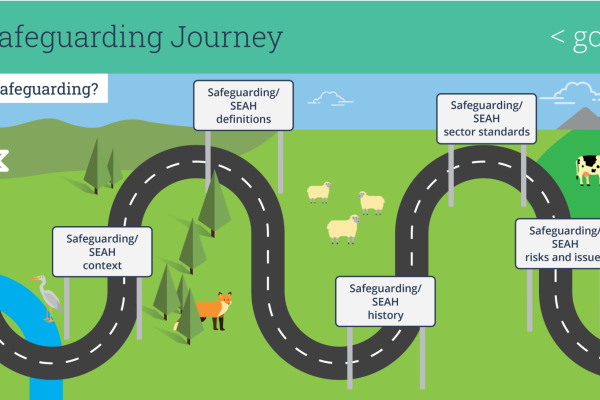
Our dedicated team of global safeguarding professionals ensure that our clients receive the highest level of technical advice and support. We start our work from wherever our client is on their safeguarding journey. We take the time to understand the organisation so we can provide support that is contextually relevant, responds to real needs and leads to success in safeguarding. We offer an explicitly intersectional feminist approach to safeguarding – in particular on the intersections of gender, race, sexual orientation, gender identity, and expression (SOGIE), and disability.
We can support you with:
Safeguarding policies, procedures, models and systems
Safeguarding knowledge building, including with tools, guidelines, training, and coaching on safeguarding.
Research and learning on what works in different contexts and for different organisations.
Incident case handling and investigation advice.
Monitoring, evaluation and learning of safeguarding efforts.
Safeguarding audits and self-assessment support. Click here to read more about our Safeguarding Framework for Organisations.
Mainstreaming safeguarding into existing or new programmes, consortia and sectors in development, humanitarian and peacekeeping settings.
Our thematic areas include:
Safeguarding against Sexual Exploitation Abuse and Harassment (SEAH)
Child safeguarding
Bullying and (non-sexual) harassment
Safeguarding in humanitarian contexts
Integrating safeguarding into high-risk projects
Digital safeguarding
Case handling and investigations
Safe research, monitoring and evaluation
We also conduct a lot of work to support organisations with their internal safeguarding policies and procedures. The outputs of these are often confidential. Here are a few examples of projects we’ve worked on recently:
Developed a global policy and Standard Operating Procedures on safeguarding for a bilateral donor.
Conducted an evaluation of a large international organisation’s safeguarding practices within human resources.
Conducted an audit of the safeguarding systems in place across different organisations working within a consortium in Ghana. Following the audit, we provided a range of technical tools and a series of trainings for consortia members on the core gaps identified in the audit.
Supported a bilateral donor’s head office to roll out safeguarding policy and procedures in country offices. We delivered a number of central guidance products including and supported three country offices with using of a diagnostic tool and develop an action plan and delivered training including on case management.
Provided technical advice to mainstream safeguarding into a range of large development programmes, including evaluations and climate programmes.
If you would like to hear more about our work on Safeguarding (SG), please reach out to Anna Gawn, Head of Safeguarding Portfolio, anna.gawn@sddirect.org.uk.
This desk-based study examines evidence and practice on financial compensation for SEAH survivors through literature review, interviews, and analysis.
This resource offers practical, experience-based guidance on GEDSI mainstreaming in practice showing how to move from strong analysis to lasting change in policies, systems and programmes.
This practical and user-friendly note supports private sector entities in addressing child safeguarding risks and impacts. The guidance aligns with established international standards, good practice in child safeguarding, and legal instruments, including the United Nations Convention on the Rights of the Child (1989), ILO Conventions on Child Labour, and the United Nations Guiding Principles on Business and Human Rights.
Drawing on insights from the Victorian Health Promotion Foundation and the Inter-Agency Network for Education in Emergencies (INEE), this resource was developed as a short note to help organisations respond to GBVH/SEAH resistance with practical, concrete tips for moving forward.
SDDirect was contracted by the International Finance Corporation (IFC) to support companies to better manage the risk of SEAH in their operations. A company self-assessment tool previously developed by SDDirect with IFC in 2021 was piloted with a small number of companies alongside the development of a toolkit for private sector companies to develop and manage community-based Grievance and Feedback Mechanisms Regarding Sexual Exploitation, Abuse and Harassment (SEAH).
This series of tip sheets that have been designed to help civil society organisations (CSOs) implement child safeguarding practices in emergency contexts. It is a three-part series helping CSOs to focus on: