Impact of COVID-19 on GBV in West and Central Africa
This report draws on the latest research, evidence and learning on the impact of COVID-19 on women and girls in West and Central Africa.
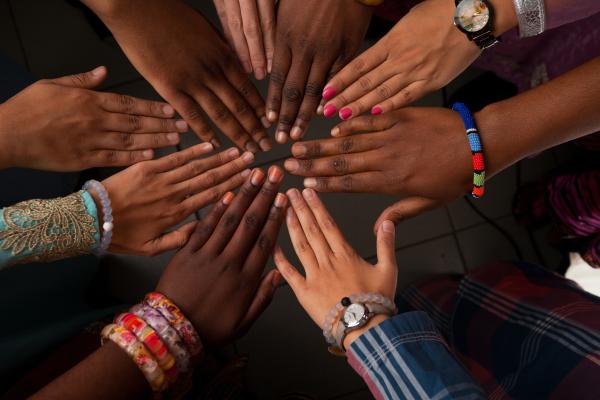 Our global Gender-Based Violence (GBV) team provides strategic technical support to actors across the GBV ecosystem from donors to community-level women-led organisations. We are a multi-disciplinary team delivering programme design and implementation support, advocacy, research reports, MEL and helpdesk services.
Our team aspires to apply our feminist principles in all our work and to support sustained and transformative change. We partner with diverse stakeholders and we take an intersectional approach to our work on GBV prevention and response across development and humanitarian contexts.
Our work includes primary prevention programming, community-level response to GBV and SEAH, school-related GBV, GBV in Emergencies, Technology-Facilitated GBV, Violence against LGBTQI+ communities, and GBV in Climate and Economic programming.
Read more about our current work or search our extensive GBV Resource Library below.
This report draws on the latest research, evidence and learning on the impact of COVID-19 on women and girls in West and Central Africa.
Ce rapport s'appuie sur les dernières recherches, données probantes et apprentissages sur l'impact du COVID-19 sur les femmes et les filles en Afrique de l'Ouest et centrale.
This resource pack provides guidance on adapting GBV case management in the context of the COVID-19 pandemic so survivors can continue to access and receive safe and confidential services.
This briefing note explores which data sources donors and GBV practitioners can rely on to inform decision-making on GBV in emergencies programming.
All work with survivors of gender-based violence (GBV) is guided by a set of principles that apply to all interactions of helpers - no matter what their role is - when engaging with survivors.
This note provides information and practical guidance to support GBV practitioners to integrate attention to disability into GBV prevention, risk mitigation and response efforts during the COVID-19 pandemic.
This resource includes a list of tools and resources which offer guidance on how storytelling might be used to explore gender-based violence (GBV) and women's rights with women and communities and support women to become more assertive in a safe way.
This evidence digest highlights selected key research and evidence in relation to livelihoods and GBV programming focusing on two areas where there is an emerging evidence based: economic strengthening interventions to prevent GBV, and cash transfer to rescue GBV risks in emergencies.
This paper explores how specialized gender-based violence in emergency programming can better address the GBV-related experiences, needs and risks facing girls aged 0-11 years.
The aim of this short guidance note is to provide international GBV responders with practical guidance on developing exit strategies and contingency plans. This is to ensure they are prepared should a GBV emergency response program be forced to close permanently and prematurely with little notice. This paper intends to fill a knowledge gap and create a resource that can offer up ways forward which improve sustainability and advance the localization of GBV prevention and response.